Showing posts with label Electrical. Show all posts

Tuesday, March 14, 2017

Electric transformer defenation

Electric Transformer
Definition of Transformer
Electrical power transformer is a static device which transforms electrical energy from one circuit to another without any direct electrical connection and with the help of mutual induction between two windings. It transforms power from one circuit to another without changing its frequency but may be in different voltage level. This is a very short and simple definition of transformer, as we will go through this portion of tutorial related to electrical power transformer, we will understand more clearly and deeply "what is transformer ?" and basic theory of transformer.

Working Principle of Transformer
The working principle of transformer is very simple. It depends upon Faraday's law of electromagnetic induction. Actually, mutual induction between two or more winding is responsible for transformation action in an electrical transformer.


Faraday's Laws of Electromagnetic Induction
According to these Faraday's laws, "Rate of change of flux linkage with respect to time is directly proportional to the induced EMF in a conductor or coil".


Basic Theory of Transformer
    Say you have one winding which is supplied by an alternating electrical source. The alternating current through the winding produces a continually changing flux or alternating flux that surrounds the winding. If any other winding is brought nearer to the previous one, obviously some portion of this flux will link with the second. As this flux is continually changing in its amplitude and direction, there must be a change in flux linkage in the second winding or coil. According to Faraday's law of electromagnetic induction, there must be an EMF induced in the second. If the circuit of the later winding is closed, there must be an current flowing through it. This is the simplest form of electrical power transformer and this is the most basic of working principle of transformer. For better understanding, we are trying to repeat the above explanation in a more brief way here. Whenever we apply alternating current to an electric coil, there will be an alternating flux surrounding that coil. Now if we bring another coil near the first one, there will be an alternating flux linkage with that second coil. As the flux is alternating, there will be obviously a rate of change in flux linkage with respect to time in the second coil. Naturally emf will be induced in it as per Faraday's law of electromagnetic induction. This is the most basic concept of the theory of transformer.

The winding which takes electrical power from the source, is generally known as primary winding of transformer. Here in our above example it is first winding. The winding which gives the desired output voltage due to mutual induction in the transformer, is commonly known as secondary winding of transformer. Here in our example it is second winding. The above mentioned form of transformer is theoretically possible but not practically, because in open air very tiny portion of the flux of the first winding will link with second; so the current that flows through the closed circuit of later, will be so small in amount that it will be difficult to measure. The rate of change of flux linkage depends upon the amount of linked flux with the second winding. So, it is desired to be linked to almost all flux of primary winding to the secondary winding. This is effectively and efficiently done by placing one low reluctance path common to both of the winding. This low reluctance path is core of transformer, through which maximum number of flux produced by the primary is passed through and linked with the secondary winding. This is the most basic theory of transformer. 

Main Constructional Parts of Transformer
The three main parts of a transformer are,

Primary Winding of Transformer- which produces magnetic flux when it is connected to electrical source.
Magnetic Core of Transformer- the magnetic flux produced by the primary winding, that will pass through this low reluctance path linked with secondary winding and create a closed magnetic circuit.


Secondary Winding of Transformer- the flux, produced by primary winding, passes through the core, will link with the secondary winding. This winding also wounds on the same core and gives the desired output of the transformer.

what is your idea in elecricity? pls comment

what is your idea in elecricity? pls comment

Direct current

Direct current
     Dc  (direct current) is the  unidirectional  flow or movement of electric charge carriers .The intensity of thebcurrent can vary with time but the general direction of movement stays the same all times. As an adjective the term DC is used in reference to voltage whose polarity never reverses.

direct current in Electrical

Direct current
     Dc  (direct current) is the  unidirectional  flow or movement of electric charge carriers .The intensity of the current can vary with time but the general direction of movement stays the same all times. As an adjective the term DC is used in reference to voltage whose polarity never reverses.

Monday, March 13, 2017

What is electric current,

what is current?
  An Electric current is a flow of electric charge. This charge is aften carried by moving electron in a conductor.
    A current  1 amp= 1 coulombs (6.24X 10^18) electrons is moving past a single point in a circuit in 1seconds
     unit  =amps
                                       I = V/R

Saturday, March 4, 2017

Electric grounding

What is grounding?
   A ground is the conductive connection between the earth or other conductive matireial in the place of earth and electric circuit or a piece of equipment.
     The principle reason of facilitating the grounding is to enable immediate diversion of heavy fault current in the event of a circuit fault  there by protection is provided against electric circuit shock hazards to people and animals.

Thursday, November 24, 2016

electrical energy saving lamb


 click link . http://www.linkbucks.com/AKwyQ

transformer instalation VIDEOS

TANSFORMER  INSTALATION VIDEO CLICK HERE  http://www.linkbucks.com/AKw9z

Electrical ohms law

                                               Ohm law
         States that the current through a conductor  between two points is directly proportional to the voltage across the two points.

                                     I= V/R

Sunday, November 20, 2016

Electrical drawing symbols

http://www.linkbucks.com/CdLO

Electrical code vidideos

http://www.linkbucks.com/CdJl

power factor


What is Power Factor?


Power factor is defined as the cosine angle between voltage and current in an alternating current (AC) circuit. Unlike in DC circuits, a phase angle difference, ϕ exists between voltage and currents in an AC circuit. The cosine of ϕ (or Cos ϕ) is termed as the power factor.

1.REACTIVE CIRCUIT (UNITY POWERFACTOR)

2.INDUCTIVE CIRCUIT (LOGGING POWERFACTOR)

3.CAPACITIVE CIRCUIT (LEADING POWER FACTOR)


If the circuit consists of inductive elements or it behaves like an inductive circuit (where current lag behind the voltage), then the power factor in that circuit is referred as a lagging power factor.


On the other hand, if the circuit is capacitive in nature where current leads the voltage, then the power factor is referred as the leading power factor. If there is no phase angle difference between the voltage and current then it is unity power factor.

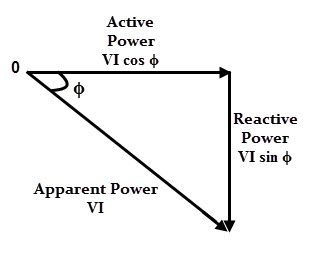
Power Traingle
Add caption
Inductive Circuit Phasor Diagram
Consider above waveforms and phasor diagram of an inductive circuit where current lags the voltage by an angle ϕ. Here, the total current is resolved into two components.

The I cos ϕ component is called wattful  or active component and it is in phase with the source voltage. The I sin ϕ component is called wattless or reactive component and it is 900 out of phase with the source voltage.

From the figure we can say that the angle from these two components decides the power factor, and it implies that if the reactive component is small, the phase angle ϕ is small resulting high power factor (In every electric circuit, power factor should be maintained high for a better utilization of power). Thus, a small reactive current in the circuit results a high power factor and vice-versa.

It is to be noted that the power factor can never be more than unity. The most efficient loading of the supply results a power factor of 1. Suppose, if the power factor of the load is 0.8 means there are much higher losses in the supply system.

Generally power factor is indicated with words lagging and leading, in addition to the value. This is to represent whether current leads or lags by the voltage. For example, 0.8 lagging implies that the circuit has a power factor of 0.8 where current lags the voltage. Sometimes, it is also indicated as a percentage such as 80% lagging.

Power factor can also be expressed in terms of power consumed by electrical equipment or a complete electrical installation. In such case power factor is defined as the ratio between the true power (KW) to the total apparent power (KVA).

Consider the above power triangle which gives the relation between various powers. The VI cos ϕ, component is called true or active power which is measured in watts (W) or Kilowatts (KW). It causes useful work in the circuit.

he VI sin ϕ, component is called wattles or reactive power and it is measured in volt-amperes-reactive (VAr) or kilo-volt-amperes-reactive (kVAr). It is caused by inductance or capacitance in the circuit and it does two main functions; to provide magnetic field and to charge capacitors.

The resultant component of true and reactive or simply a VI component is called apparent power and it is measured in volt-amperes (VA) or kilo-volt-amperes (kVA).

From the figure, power factor, cos ϕ = active power/ apparent power = VI cos ϕ/ VI

cos ϕ = KW/KVA


The above expression of power factor measures how efficiently electric power is converted into useful work output. And also, from the power triangle, reactive power component measures the power factor. If the reactive power component is small, the power factor will be high and vice-versa.